


OPC UA/DA Client Plug-In for OPC Router - License type: Subscription license for 1 year

This OPC Router plug-in enables you to read/write data from/to OPC UA/DA servers. It is an OPC Router accessory. In the OPC Router, data can be mathematically processed and, using other OPC Router plug-ins, transferred to various systems and devices. Más
Código del producto: OPCR-OPCCLI-SUB-PROD
This OPC Router plug-in enables you to read/write data from/to OPC UA/DA servers. It is an OPC Router accessory. In the OPC Router, data can be mathematically processed and, using other OPC Router plug-ins, transferred to various systems and devices. Más
Código del producto: OPCR-OPCCLI-SUB-PROD
Opciones 9
| License type | Código | Disponibilidad | Precio sin IVA | |
|---|---|---|---|---|
| Subscription license for 1 year | OPCR-OPCCLI-SUB-PROD | En stock |
465 EUR
|
|
| Subscription license for 2 years | OPCR-OPCCLI-SUB-PROD 2x | En stock |
930 EUR
|
|
| Subscription license for 3 years | OPCR-OPCCLI-SUB-PROD 3x | En stock |
1 395 EUR
|
|
| Perpetual (permanent) license with 1 year support | OPCR-OPCCLI-PRP-PROD + OPCR-OPCCLI-ATT-PROD | En stock |
1 081 EUR
|
|
| Perpetual license with 2 years support | OPCR-OPCCLI-PRP-PROD + OPCR-OPCCLI-ATT-PROD + OPCR-OPCCLI-EXT-PROD | En stock |
1 283 EUR
|
|
| Perpetual license with 3 years support | OPCR-OPCCLI-PRP-PROD + OPCR-OPCCLI-ATT-PROD + 2x OPCR-OPCCLI-EXT-PROD | En stock |
1 485 EUR
|
|
| Perpetual license support extension for 1 year | OPCR-OPCCLI-EXT-PROD 1x | En stock |
202 EUR
|
|
| Perpetual license support extension for 2 years | OPCR-OPCCLI-EXT-PROD 2x | En stock |
404 EUR
|
|
| Perpetual license support extension for 3 years | OPCR-OPCCLI-EXT-PROD 3x | En stock |
606 EUR
|
OPC Router is a software program that allows you to connect data from various industrial devices and IT/OT systems to each other. All this quickly, automatically and without programming knowledge. In addition, you can see all data flows in a clear visualization.
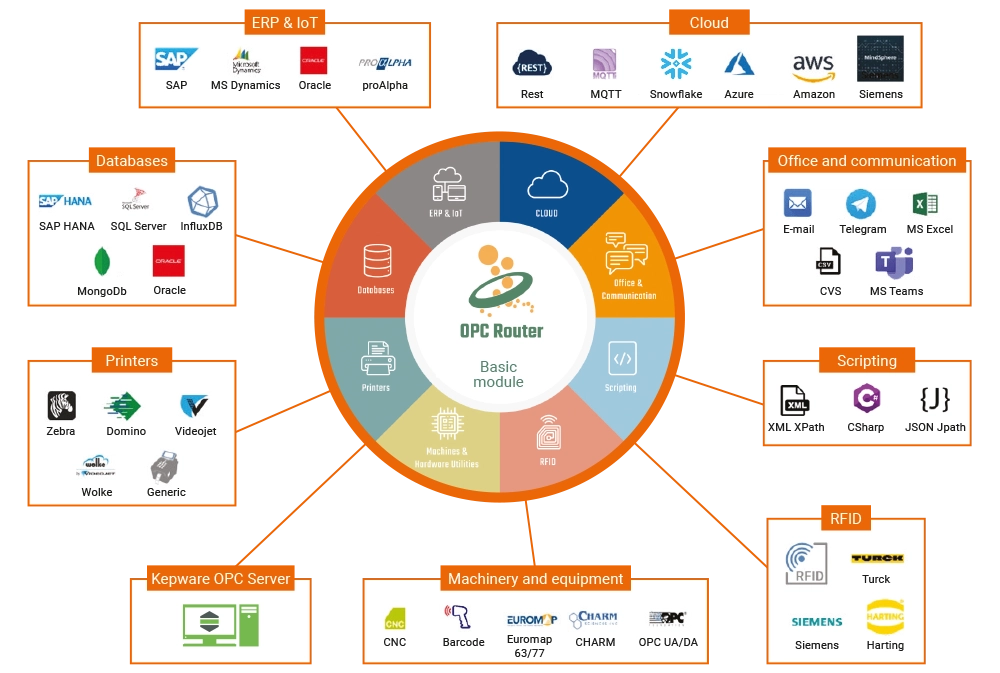
Collect data, connect systems, perform calculations, compare values and enter results into databases. You can do all this with OPC Router for PLC systems, OPC servers, printers, RFID readers, emails, Excel spreadsheets, databases, cloud systems, MQTT brokers, ERP systems SAP R3, SAP HANA, etc. For installation on a single computer you need a basic module and one or more plug-in modules.
OPC UA/DA Client plug-In
Used at every automation level, the OPC protocol is a common language that enables various hardware and software systems to exchange data. The OPC Router with the OPC UA/DA Client plug-in acts as OPC client, supporting the OPC UA and OPC DA protocols. With the OPC Router, via an OPC server, you can read and write data from/to PLCs, CNCs, robots and hundreds of other devices. The OPC Router also allows you transfer data from all of these systems to other systems, for example databases, MES and ERP.
The OPC Router is a great tool for those who work with KEPServerEX from the company Kepware. With over 150 supported communication drivers, KEPServerEX enables you to connect to PLC and other systems and convert their data formats to the OPC DA/UA protocols. This standardised data can then be transferred to the OPC Router via its OPC plug-in and to IT and OT systems via its other plug-ins.
Read and Write Operations with OPC UA Client
In the picture below, you can see an example of using the OPC UA Client for reading and writing data from/to a database. Whenever the value of the PalletNumber tag changes, the Data change trigger (1) triggers a connection. Information about the pallet (2) is read out from the OPC UA server. This information is transferred to the database (3) and information about the pallet's storage and any error codes are sent back to the OPC UA server (4).

Configuration
Before you can start to read data from an OPC server, you need to configure the OPC client. Your choice and configuration of the OPC client plug-in depends on the type of OPC server that you will read data from. You can choose between the OPC UA plug-in and the OPC Classic plug-in. When you have configured your plug-in, you can start to create connections and read data from the OPC server.
 OPC UA Client Configuration
 OPC Classic Client Configuration
Transfer Objects and Triggers
Data transfers in the OPC Router are configured with the use of graphical objects and the drag & drop function. When you purchase the OPC UA/DA Client plug-in, the following transfer objects and triggers will become available to you.


Requisitos del sistema
Instalación y actualización
El paquete de instalación de OPC Router instala el entorno de configuración, los servicios de Windows y todos los plug-ins en modo demo con un tiempo de ejecución de 2 horas. Los plug-ins licenciados solo pueden ejecutarse sin límite de tiempo después de introducir la clave de licencia.
La instalación no incluye ningún sistema de base de datos ni servidor OPC para uso en producción. Estos componentes deben instalarse por separado y luego conectarse en la configuración de OPC Router.
Rendimiento del ordenador
OPC Router es una aplicación de servidor, por lo que recomendamos ejecutarlo en un hardware adecuado. Para una implementación habitual, recomendamos:
- procesador multinúcleo,
- mínimo 8 GB de RAM,
- almacenamiento SSD.
Sistema operativo
Para el uso en producción recomendamos sistemas operativos Microsoft Windows Server. También se pueden utilizar sistemas operativos cliente de 64 bits, especialmente para pruebas.
Sistemas operativos compatibles:
- Windows Server 2016 x64
- Windows Server 2019 x64
- Windows Server 2022 x64
- Windows Server 2025 x64
- Windows 10 x64
- Windows 10 IoT x64
- Windows 11 x64
Ejecución en Docker
OPC Router también puede ejecutarse en un contenedor Docker, por ejemplo en un dispositivo Edge o en un dispositivo con Windows. Los requisitos mínimos para ejecutarlo en un contenedor Docker son:
- procesador de un solo núcleo de 64 bits a 600 MHz con soporte AVX,
- 512 MB de RAM,
- 3 GB de espacio libre en disco.
.NET 8
OPC Router requiere el entorno .NET 8. Si no está instalado en el sistema, la instalación de OPC Router lo instalará si es necesario.
En entornos de producción recomendamos instalar .NET 8 manualmente desde Microsoft antes de actualizar OPC Router. La instalación de .NET puede requerir actualizaciones de Windows, tardar más tiempo y, en algunos casos, requerir varios reinicios. Para reducir el tiempo de parada, recomendamos desinstalar las versiones anteriores de .NET solo después de que .NET 8 se haya instalado correctamente.
Servidor OPC
Para conectar sistemas de control mediante OPC, debe estar disponible un servidor OPC instalado y accesible. OPC Router admite conexiones mediante OPC DA 4.0, OPC UA y OPC XML.
Para la comunicación con un servidor OPC se requiere el plug-in OPC correspondiente.
Servidor de base de datos y fuentes de datos
Los servidores de bases de datos no forman parte de la instalación de OPC Router. Si desea conectarlos con OPC Router, deben instalarse y ponerse a disposición por separado.
OPC Router admite la conexión con los siguientes sistemas de bases de datos e interfaces:
- Microsoft SQL Server
- Oracle
- MySQL
- SAP HANA
- OLE DB
- sistemas accesibles mediante ODBC
También es posible conectar las siguientes bases de datos, fuentes de datos o archivos:
- MS Access
- SQLite
- dBase
- InfluxDB
- MongoDB
- archivos XML
Los plug-ins para la comunicación con bases de datos no están incluidos en la licencia Basic. Para cada tipo concreto de conexión a base de datos, es necesario seleccionar el plug-in correspondiente.
Conexión a base de datos Oracle
Para conectarse a una base de datos Oracle, es necesario tener instalado Oracle Instant Client (ODAC).
SAP Plug-in
El SAP Plug-in es compatible con sistemas SAP versión 4.0b o superior. En el ordenador con OPC Router debe estar instalado SAP Logon Pad o la biblioteca librfc32.dll.
Para utilizar SAP NetWeaver, es necesario instalar SAP NetWeaver RFC SDK.
El SAP Plug-in es un módulo con licencia independiente y no está incluido en la licencia Basic.
New features in the OPC Router 5.1 data hub
The new version of OPC Router 5 brings some big changes. The biggest change is the user interface, which brings the user more comfort when working with the program and the ability to work in Linux, macOS, etc. There are also new options for creating user accounts, improvements in application performance optimization and many other improvements.
Highlighted items are mandatory.

OPC Router – módulo básico
286,77 EUR IVA incl.
TOP 30 OPC UA and OT/IT Data converters in a Single OPC Router License
2 407,90 EUR IVA incl.
Productos relacionados2
OPC Router – módulo básico
286,77 EUR IVA incl.
TOP 30 OPC UA and OT/IT Data converters in a Single OPC Router License
2 407,90 EUR IVA incl.